
Airrex Diesel Heaters Power a Scottish Rally Workshop

A professional rally team in Scotland heats its workshop with three Airrex diesel infrared heaters, the oldest in use for ~12 years. Fuel consumption is extremely low and noticeably lower than their previous noisy, smelly diesel blowers. Reliability is described as “fantastic,” with minimal maintenance needed. The heaters are also transported to international rally events to keep service areas warm. In the Scottish Borders, where cold, damp winters are a part of daily life, a professional rally team has built a workshop environment that keeps pace with the demands of world-level motorsport. Their facility in Kelso includes several work areas: the main workshop, a dedicated transmission and engine rebuild room, and a paint shop. Much of the building is insulated, helping maintain stable temperatures during intensive winter workloads. The team runs a full rally car programme, building, preparing, repairing, and rebuilding modern machines that compete in championships across the world. Reliability, precision, and properly controlled working conditions are essential — both for the crew and the cars. Twelve Years with Airrex Infrared Heaters The workshop operates three Airrex diesel infrared heaters, the oldest of which has been running for around 12 years, still performing without issues. According to owner Dommy Buckley, Airrex stood out immediately: “They’re a class apart. Very economical and so clean burning. You can’t get better.” The heaters are used seasonally but continuously throughout the winter, from October to April, non-stop every day. The team even transports their diesel heaters to colder international rally events in France, Finland, and Norway, relying on them to keep service areas warm in harsh outdoor conditions. Stable Heat from a Space Heater — Even with Doors Opening The workshop features a gable-top roof with a high peak, which can easily lead to rising heat loss. To compensate, the team uses a small air-blower fan to push warm air back down to the work area. Together with Airrex’s infrared heating technology, it keeps the space warm and consistent even when doors are constantly opening. According to owner Dommy Buckley, “It works a treat.” Fuel Efficiency That’s Hard to Believe Fuel consumption is one of the first things people ask about — and it’s also where the workshop has seen one of the biggest differences. When talking about it, Buckley can’t help but laugh: “It’s like nothing! Honestly… we’re a spreadsheet-free environment, but it’s easy to work out they’re efficient.” Airrex diesel infrared heaters are designed to use far less fuel than traditional blown-air diesel units, and the team sees this daily in both their running costs and overall comfort. Before switching to Airrex, they relied on older heaters that Dommy remembers all too well: “Terrible, noisy, smelly prehistoric machines.” The contrast was immediate. With Airrex, fuel use dropped sharply, the exhaust smell disappeared, and the workshop environment became quieter, cleaner, and far more pleasant to work in. Maintenance and Reliability of Their Diesel Heaters While the team has occasionally used a Service Kit, most of the maintenance today is handled by Rex Nordic’s Darren, whose expertise has made the whole process effortless. As Buckley puts it: “Darren’s skills are much better and easier to just get him to do it!” Reliability is another area where the heaters have stood out. When asked to summarise their performance over more than a decade of use at the workshop — and on the road — Dommy doesn’t hesitate: “F A N T A S T I C ……” The heaters require minimal attention, deliver consistent heat regardless of the environment, and have become a trusted part of the team’s operation. Dommy has recommended them widely: “I’ve recommended them to a lot of people. All spaces — they work anywhere, really.” From insulated workshops to temporary outdoor service zones at international rally events, Airrex diesel infrared heaters have proven to be dependable partners wherever the team goes. Motorsport Workshop (Scotland) Type: Rally car workshop Structure: Mostly insulated, gable-top roof Heating: Three Airrex diesel infrared heaters (oldest ~12 years) Usage: Daily from October–April Previous heating: Noisy, smelly, blown-air diesel units Fuel use: Very low (“like nothing”) Reliability: Excellent, trouble-free Maintenance: Minimal; serviced by Rex Nordic technician Extra use: Taken to rally events abroad
Considering a diesel heater? Tubular fan heater or a safe infrared heater?
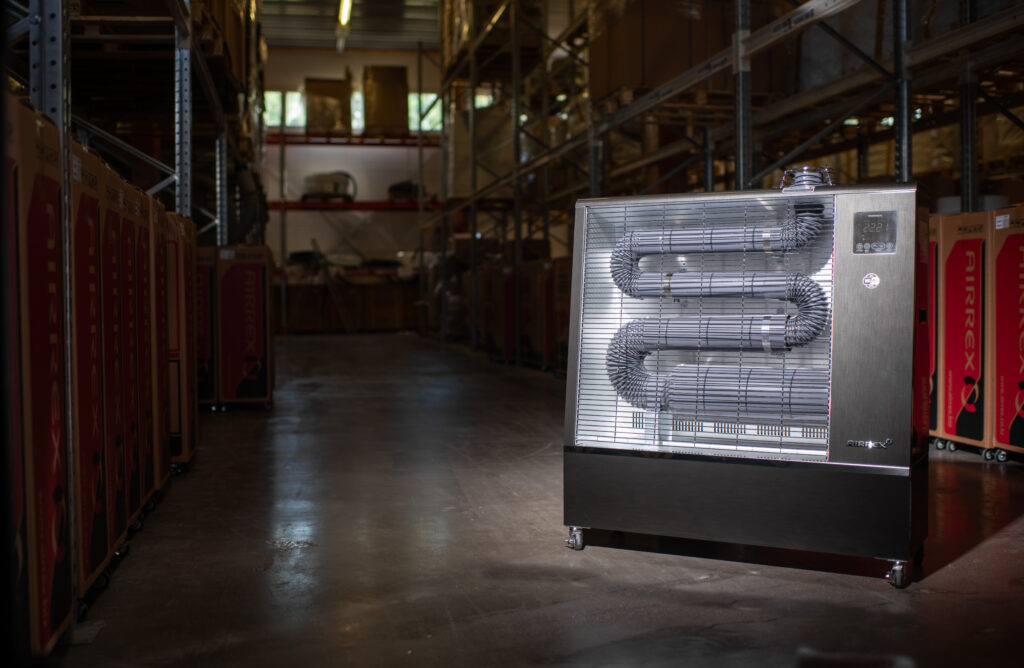
The energy contained in diesel or fuel oil can be used for heating by burning the oil. Simple traditional auxiliary heaters consist only of an oil burner and a fan that is used to direct the heat from the oil burner to the desired spot in the form of hot airflow. Airrex infrared heaters also include an oil burner, but instead of a naked flame, the heat is formed in a heat generator doubling as the exhaust system. From the heat generator, the heat is radiated to the surrounding atmosphere in the form of infrared waves. The heat radiation can be directed using the heat reflector structures in the heater. Single- or multi-stage combustion diesel heaters The forced airflow of traditional oil heaters with a burner and fan transfers all particles of the burned oil, including exhaust gases and unburned particles, directly through the heater into the heated space. Even with an efficient burner, the exhaust gas will contain small amounts of unburnt hydrocarbons and any contamination in the fuel. This will cause different kinds of smoke and odour emissions. Basic tubular heaters simply use the fan to circulate the air in the heated space pass the oil burner. This means that unburnt hydrocarbons from the oil burner “supplement” any impurities already in the heated space air. The amount of unburnt hydrocarbons increases significantly if the diesel or fuel oil does not burn efficiently. This is usually the case during the starting or stopping of the heater or if there is a problem with the fuel supply to the burner. Airrex infrared heaters burn the diesel or fuel oil very efficiently because, after the oil has been burned in the burner, practically all the remaining hydrocarbons are burned in the 3-stage exhaust system that doubles as the heat generator. In practice, the exhaust is left with only harmless carbon dioxide and water without any unburnt hydrocarbons causing unpleasant odours and/or health hazards. Airrex auxiliary heaters utilise practically all the energy contained in the fuel, meaning that they are highly efficient and consume very little fuel. Exposed or protected oil burner? Basic fan-equipped diesel and fuel oil heaters have their oil burners in direct contact with the outside air, exposing them to any impurities and humidity in the air. This can result in corrosion or dirt build-up in the burner structures, decreasing the performance and reliability of the burner. If you use a fan-equipped auxiliary heater with an oil burner as the heat source, you must always make sure that the air going inside the heater does not contain any combustible material, such as dust, straws of hay or any combustible material that can be carried by the airflow. Another thing to remember when using this kind of a heater is that you also must consider the fire hazard caused by the hot air coming from the heater and any smouldering particles carried in it. In Airrex infrared heaters, the oil burner is enclosed inside the device and has its own separate air intake channel. All air coming to the burner is burnt, and the resulting exhaust gases are directed to a long exhaust system that doubles as the heat generator. The flame of the burner is not in contact with the surrounding space, and exhaust gases and any sparks cool down and die out harmlessly in the exhaust system. The long exhaust system also protects the burner against damages due to any impurities and humidity in the air. Difference between heating by airflow and heating by radiation In case of a traditional oil burner, the hot naked flame heats the air directed past it by the fan. This means that the air in front of the auxiliary heater may be very hot. The heating effect becomes more even when the hot air mixes with ambient air. The heating effect of the heated air circulated by the fan can only be felt in places where the air can reach. In a large space with obstacles or structures blocking the airflow, there will be “nooks and crannies” where the heat cannot get. Heat energy radiated by an infrared heater does not heat the air but the objects with which it comes in contact. Therefore, you can be close to the heater without feeling uncomfortably hot. Heat radiation spreads evenly in the space, literally warming up the objects in its path from the inside out. Once the objects and structures in the heated space warm-up, they also warm up the space evenly. Do you want to circulate dust and air contaminants? Fan-boosted air circulation always circulates contaminants, dust and other impurities in the space as well. This spreads air contaminants everywhere, including people’s skin and lungs and from there further in the body. Heat radiation from an infrared heater does not cause any superfluous air movement that would cause dust or any contaminants in the heated space to migrate to the workspaces or supplies or in the bodies of people there. Humming fan and buzzing burner – or not? The humming sound of an efficient oil burner is familiar to all who have been around one. Traditional auxiliary heaters only have sound damping structures on the sides of the burner. And to ensure safe heater operation, the heated air must be made to move efficiently. This requires a fan that inevitably produces noise. Today, some high-end traditional auxiliary diesel heaters already have reasonably silent fans. In case of the fully enclosed Airrex infrared heaters, the air to the oil burner is conveyed via a separate sound dampening channel. The exhaust system located downstream the burner utilises any energy left from the burned oil and also dampens the “exhaust noise” down to a very moderate level. Airrex infrared heater’s noise level is 48 dB, corresponding with that of a quiet speaking voice. Burner requires electricity – a fan easily doubles the need for power Traditional auxiliary oil heaters have some components that require electric power: fuel pump, oil burner with the associated control electronics and the fan that
Targeted Cooling in Large Spaces Can Save Up to 30% in Energy
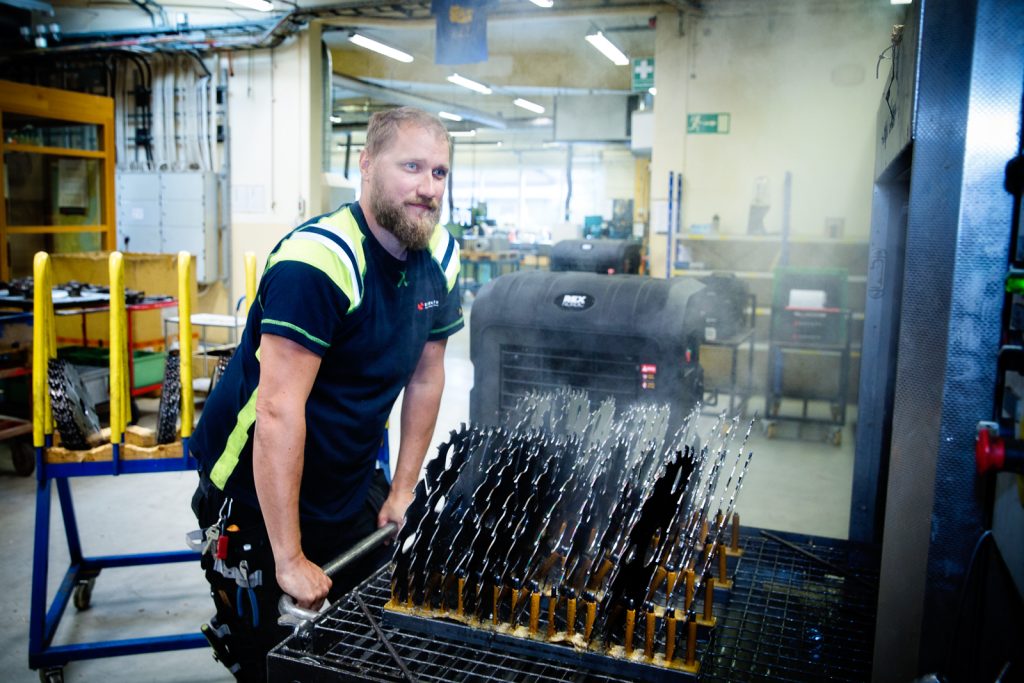
Instead of wasting energy cooling unused areas, targeted cooling focuses specifically on zones that require it, making it a more efficient and cost-effective solution for businesses and industrial facilities. This article delves into the benefits of targeted cooling, explaining why it is the best choice for professional use in large spaces, and how it can economically, environmentally, and practically benefit your company. Energy Savings and Efficiency For businesses, energy consumption is a significant expense, and cooling an entire space consumes much more energy than targeted cooling. Targeted cooling focuses on cooling only the areas where employees and equipment need it, such as workstations, meeting rooms, or specific production lines. Studies have shown that targeted cooling can reduce energy consumption by up to 30% compared to traditional whole-space cooling systems (MDPI). This makes it particularly appealing for large spaces and companies where energy costs can be substantial. Rex Nordic’s mobile air heat pumps and evaporative coolers, known as eco-coolers, are designed to maximize energy efficiency. They can quickly and efficiently cool specific areas, making them an ideal choice for businesses looking to keep energy costs in check without compromising comfort. Environmental Friendliness Companies are becoming increasingly aware of their environmental impact, and reducing energy consumption is a key part of sustainable business practices. Targeted cooling reduces energy consumption and thereby also the carbon footprint. This is especially important for companies aiming to meet environmental standards and improve their sustainability goals. According to a report by the U.S. Department of Energy, targeted cooling can significantly reduce carbon dioxide emissions, particularly in large industrial facilities. Research by the European Environment Agency (EEA) also highlights that targeted cooling is an effective way to meet growing cooling demands while supporting EU energy and climate goals. Convenience and Flexibility Large spaces such as warehouses, production facilities, and office complexes benefit from the flexibility of targeted cooling. With targeted cooling, you can easily focus on the areas that need it most, such as workstations where employees spend most of their time. Rex Nordic’s mobile air heat pumps and evaporative coolers are easy to use and require no installation. Additionally, these devices are portable, so you can use them as needed in different departments or workspaces. Cost-Effectiveness Whole-space cooling systems are generally expensive to install and maintain. Targeted cooling offers a cost-effective alternative. Lower costs and reduced energy consumption make it a financially sensible choice for businesses. Rex Nordic’s products offer excellent value for money. They are durable and long-lasting, meaning the investment will pay off in the long run. Additionally, their ease of use and low maintenance requirements keep operating costs low. Summary Targeted cooling offers several advantages over whole-space cooling, especially in professional use and large spaces. It is energy-efficient, environmentally friendly, cost-effective, and improves comfort and employee health. Rex Nordic’s mobile air heat pumps and evaporative coolers are excellent choices that meet these needs by providing efficient and economical cooling. Consider targeted cooling the next time you look for cooling solutions for your business – it is a wise choice for both business and environmental reasons.
Warmth that stays – Airrex heater keeps the workshop comfortable all winter
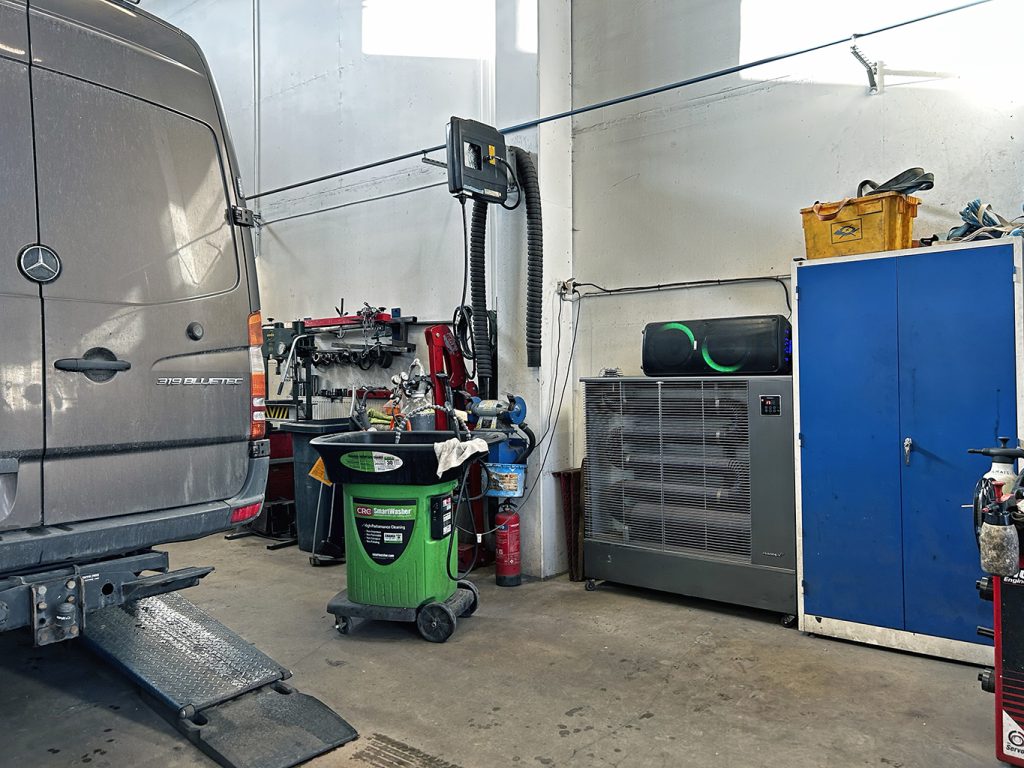
A 244 m² car repair workshop with six-meter-high ceilings is not the easiest space to keep warm during Finnish winters. Concrete walls, a partially insulated sheet-metal roof, and a frequently opened overhead door allow heat to escape easily. Thanks to the Airrex diesel space heater, the hall maintains a steady temperature of +16–17 °C throughout the winter. Janne Mukkala, owner of JM-Konehuolto Oy from Finland, has been using the Airrex heater for six years – and wouldn’t switch to anything else. “The heater has worked flawlessly. It starts automatically when the door has been open and the temperature drops, and it quickly brings the warmth back. Reliability is what I value most.” A fuel-powered heater that supports district heating in freezing weather Before installing the Airrex, the workshop’s temperature fluctuated constantly during the winter. District heating alone wasn’t enough to keep the workspace comfortable, especially when the overhead doors were opened in sub-zero conditions. The Airrex diesel space heater provided the extra boost that was missing. “Now we can open the door as often as needed without losing the indoor warmth,” says Mukkala. “Airrex works as a fuel-powered supplementary heater that reacts quickly to temperature changes and supports the district heating system.” An energy-efficient heater like Airrex is an excellent choice for garages or workshops where efficient, odorless heat is needed without complicated installation. At JM-Konehuolto, the unit is used daily throughout the winter season, sometimes even overnight. Airrex – easy to use and built to last The Airrex infrared heater has been operating in the workshop for six years without a single service need. “I’ve never had to do anything to it – it just works.” Thanks to its advanced oil burner technology and simple design, Airrex is nearly maintenance-free. The heater operates quietly and odorlessly, without smoke or fumes inside the building. We still recommend replacing the annual service kit to maintain optimal performance and energy efficiency year after year. A satisfied user – warm workshop, minimal effort Simple, reliable, and economical – that’s how many Rex Nordic customers describe the Airrex infrared heaters. “It has been the most reliable heating solution we’ve ever had,” says Mukkala. Airrex perfectly complements district heating and keeps the workshop warm all winter long, even though insulation isn’t perfect and the doors are opened frequently. Who is the Airrex diesel space heater for? The Airrex diesel space heater is ideal for garages, repair shops, warehouses, and workshops – any space that requires efficient heating and ease of use. Thanks to its mobility, the unit can be easily moved wherever warmth is needed. The fuel-powered heater also performs reliably in locations where electrical power is limited or traditional heaters fall short. Facts: JM-Konehuolto Oy, Finland Type of business: Car repair workshopFacility size: 244 m² | Height 6 mStructure: Concrete walls and floor, partially insulated metal roofHeating solution: District heating + Airrex AH-800i diesel space heaterUsage: Daily during winter, occasionally overnightIn operation: 6 years | No maintenance requiredMaintained temperature: +16–17 °C