



Rex Nordic Diesel Heaters Keep a Scottish Rally Shop Warm

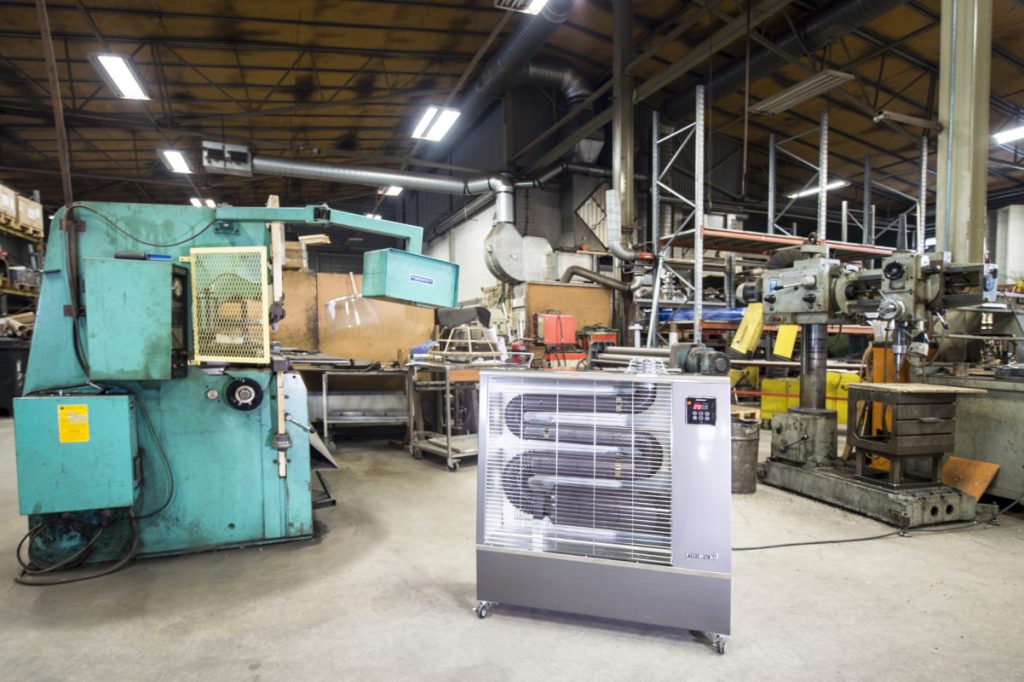
A professional rally team in Scotland heats its shop with three Rex Nordic diesel infrared heaters, including one that has been running for about 12 years. Fuel consumption is extremely low, far lower than the team’s previous loud, smelly diesel blowers. Reliability is described as “fantastic,” with almost no maintenance needed. The heaters travel with the team to international rally events to keep outdoor service areas warm. In the Scottish Borders— where cold, damp winters are the norm— a professional rally team has built a shop environment capable of supporting world-class motorsport work. Their facility in Kelso includes multiple work zones: the main workshop, a dedicated transmission and engine rebuild room, and a paint booth. Much of the building is insulated, helping maintain consistent temperatures during heavy winter workloads. The team runs a complete rally car program, building, preparing, repairing, and rebuilding modern race cars that compete in championships across the world. Reliability, precision, and controlled working conditions are essential for both the crew and the cars. Twelve Years with Rex Nordic Infrared Diesel Heaters The shop uses three Rex Nordic diesel infrared heaters, the oldest operating for roughly 12 years and still performing without issues. According to owner Dommy Buckley, Rex Nordic stood out immediately: “They’re a class apart. Very economical and so clean burning. You can’t get better.” The heaters are used seasonally but run daily throughout the winter, from October to April. The team also brings their heaters to international rallies in France, Finland, and Norway, relying on them to keep service areas warm in harsh outdoor conditions. Stable Heat from a Mobile Heater — Even with Doors Constantly Opening The shop has a gable-top roof with a high peak, which naturally causes heat to rise. To counter this, the team uses a small fan to push warm air back down into the work area. Combined with Rex Nordic’s infrared technology, the setup keeps temperatures stable even when doors are frequently opening and closing. According to Buckley, “It works a treat.” Fuel Efficiency That’s Hard to Believe Fuel consumption is usually the first question people ask— and it’s also where the team noticed the biggest change. Buckley laughs when he talks about it: “It’s like nothing! Honestly… we’re a spreadsheet-free environment, but it’s easy to work out they’re efficient.” Rex Nordic diesel infrared heaters are engineered to use far less fuel than traditional blown-air diesel heaters, and the team sees the difference daily, in operating costs and in overall comfort. Before switching to Rex Nordic, they used heaters Dommy remembers all too well: “Terrible, noisy, smelly prehistoric machines.” The difference was immediate. The fuel consumption dropped dramatically, the exhaust odor disappeared, and the shop became quieter, cleaner, and much more pleasant to work in. Maintenance and Reliability While the team has occasionally used a Service Kit, most maintenance today is handled by Rex Nordic’s Darren, whose expertise makes the whole process effortless. Buckley says: “Darren’s skills are much better and easier to just get him to do it!” Reliability is another strong point. Asked to summarize more than a decade of use — both in the shop and on the road — Dommy doesn’t hesitate: “F A N T A S T I C ……” The heaters require very little attention, deliver consistent heat in any environment, and have become a trusted part of the team’s operations. Dommy recommends them widely: “I’ve recommended them to a lot of people. Any space — they work pretty much anywhere, really.” From insulated shops to temporary outdoor service zones at international rally events, Rex Nordic diesel infrared heaters have proven to be dependable partners wherever the team goes. Motorsport Shop (Scotland) Type: Rally car workshop Structure: Mostly insulated, gable-top roof Heating: Three Rex Nordic diesel infrared heaters (oldest ~12 years) Usage: Daily, October to April Previous heating: Noisy, smelly, blown-air diesel units Fuel use: Very low (“like nothing”) Reliability: Excellent, trouble-free Maintenance: Minimal; supported by Rex Nordic technician Additional use: Taken to rally events abroad
Rex Nordic heaters – An eco-friendly choice with renewable diesel
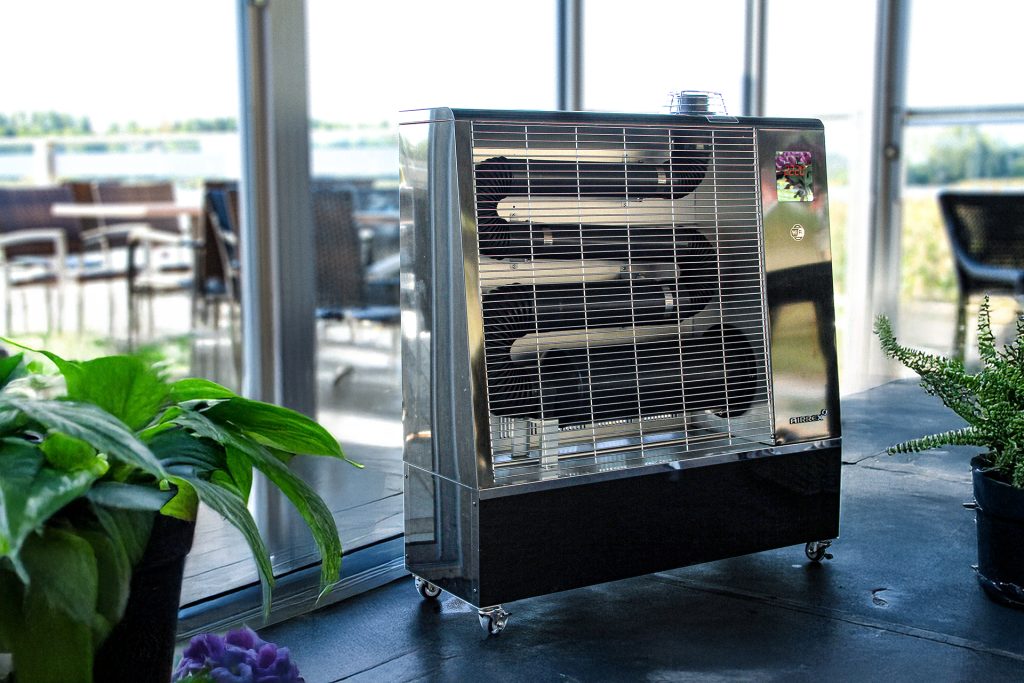
Rex Nordic heaters are the perfect choice for those looking to reduce their carbon footprint without sacrificing performance. These heaters operate efficiently on both traditional diesel and fossil-free renewable diesel, ensuring 100% fuel efficiency and low fuel consumption. Summary Rex Nordic heaters run on both traditional diesel and fossil-free renewable diesel, reducing carbon emissions. Innovative technology maximizes fuel energy use, ensuring low fuel consumption. In many cases, renewable diesel is a more eco-friendly heating option than electricity, especially in regions where power is generated from fossil fuels. Using renewable diesel for heating is a tangible step toward a fossil-free future, and Rex Nordic heaters support this transition without compromising performance. Efficient and clean heating without emissions Rex Nordic heaters utilize advanced fuel-efficient technology, ensuring all fuel energy is fully utilized. Their three-phase system directs infrared heat waves straight into the surrounding area. This method not only saves energy but also enables precise heat targeting with reflector structures. As a result, heating with Rex Nordic is both economical and environmentally friendly. Renewable diesel – The environmentally friendly heating solution Diesel often gets unfairly associated with fossil fuels, yet modern diesel technology has evolved significantly, allowing for clean and efficient use of fossil-free fuels like renewable diesel. This sustainable fuel is a viable alternative for both heating and transportation, offering a significant reduction in environmental impact. Rex Nordic heaters are at the forefront of this progress. With cutting-edge product development, Rex Nordic heaters function seamlessly with renewable diesel, which is not always the case with conventional diesel heaters. When using renewable diesel, Rex Nordic heaters significantly reduce emissions compared to electric heating systems—especially in countries where electricity production still relies heavily on fossil fuels. This makes renewable diesel an eco-friendly alternative with a lower environmental impact. Electricity vs. renewable diesel in heating Comparing renewable diesel to electric heating, renewable diesel is often the more sustainable choice. For example, in the EU, the average CO₂ emissions from electricity production range between 200–300 g CO₂/kWh, meaning that electric heating can have a higher carbon footprint than a fuel-burning heater using renewable diesel. Rex Nordic heaters not only reduce dependence on fossil fuels but also offer significant energy savings. This makes them an ideal heating solution for large spaces requiring constant and efficient heating, such as garages, industrial halls, warehouses, and construction sites. A fossil-free future Reducing fossil fuel consumption is a key part of building a sustainable future. Using renewable diesel for heating is a tangible step towards a fossil-free world, and Rex Nordic heaters make this transition easy—without compromising performance or usability. The benefits of renewable diesel extend beyond emissions. Its production supports local circular economies, as raw materials can be sourced locally, and manufacturing can be conducted regionally. This not only supports ecological goals but also benefits local economies. Rex Nordic heaters exemplify how modern technology can drive the shift toward a more sustainable future. Rex Nordic heaters are next-generation solutions for eco-friendly and cost-effective heating. They are the ideal choice for businesses that prioritize sustainability, efficiency, and responsibility. Discover our selection of diesel heaters today! Renewable diesel vs. biodiesel – Which is better? Renewable diesel (HVO) is technically superior to biodiesel (FAME, RME) due to:✔ Compatibility: Works directly with existing diesel engines✔ Better cold-weather performance✔ Greater emission reductions✔ More consistent fuel quality, regardless of raw materials Biodiesel is cheaper to produce but comes with technical issues and lower environmental benefits. EU regulations limit biodiesel blending in diesel fuels to 7%, whereas renewable diesel has no blend restrictions and can be used in pure form. We recommend using only renewable diesel in Rex Nordic heaters. Biodiesel (FAME, RME) must not be used.
Rex Nordic diesel heater – reliable warmth, real fuel savings

Efficient heating isn’t just about power – it’s about getting warmth where it matters and keeping it there. Rex Nordic diesel infrared heaters have proven across Finland’s harsh winters that consistent comfort doesn’t have to mean high operating costs. The following real-life examples from Finland show how Rex Nordic keeps large warehouses and workshops warm throughout long winters – while using surprisingly little fuel. Proven results with infrared heating: only 0.66 gallons per day Many users are surprised to see how little fuel Rex Nordic diesel heaters actually consume. They’re built to heat large spaces evenly and efficiently, without wasting energy. Grels Ström, a retired technical specialist from Rex Nordic, uses a Rex Nordic heater in his 5,400 sq ft (500 m²) warehouse. The building has ceiling insulation, drywall walls, and a concrete floor – an ideal structure for retaining heat. Previously, the space was heated with direct electric heaters, but switching to diesel cut both energy use and costs dramatically. Ström explains: “At first, fuel use can be a bit higher. It usually takes about a week or so for consumption to stabilize. Infrared heat is absorbed directly into the structures, and once they’re fully warm, it takes surprisingly little fuel to keep the temperature steady.” He maintains an indoor temperature of about 59 °F (15 °C) even when it’s freezing outside. Once the building is fully warm, daily fuel consumption averages just 0.66 gallons (2.5 liters) of diesel. The Rex Nordic heater has run reliably for years without any issues or need for service. A slightly higher initial fuel use is completely normal. Building materials often contain moisture that must dry out first. Once dry, the heating system runs at peak efficiency – and the savings are immediate. This is where Rex Nordic infrared technology truly stands out: the heat is stored in the building’s structure and released steadily. After that, only short heating cycles are needed to maintain comfort, and the savings show directly on the fuel bill. Smart thermostat keeps fuel use to a minimum Every Rex Nordic infrared heater comes with a built-in thermostat designed to keep fuel consumption as low as possible. The heater starts and stops automatically to maintain the target temperature. Diesel is metered precisely – only as much as needed, never more – keeping use to an absolute minimum. In everyday operation, the heater works independently. Once the structure is warm, it maintains a steady temperature with short operating intervals. There’s no need for constant adjustments – the thermostat takes care of everything automatically. Unlike traditional forced-air heaters, Rex Nordic units don’t blow hot air to the ceiling or lose it when doors open. Infrared heat radiates directly into walls, floors, tools, and machinery, which absorb and store the warmth. When doors are opened, the stored heat in the structures quickly restores the indoor temperature. Long-term savings proven in Finland Another example comes from Markku Ojanen, who heats a 1,695 sq ft (480 m³, 10 ft high) insulated building. It was previously heated with radiators and fan heaters that consumed about 660 gallons (2,500 liters) of oil each year. After switching to a Rex Nordic AH-310 diesel heater, the difference was immediate. During the first winter, fuel use dropped to around 264 gallons (1,000 liters) per year – less than half of what it was before. He maintains a steady indoor temperature of 48–50 °F (9–10 °C) and raises it to 55 °F (13 °C) while working. Over ten years, the total savings have reached roughly $10,000–$12,000, and the same heater is still running flawlessly. “Maintenance has been done on schedule, but it’s never needed a single repair,” Ojanen says. “It just keeps going.” Sustainable heat that lasts Rex Nordic infrared heating works on a simple but powerful principle: instead of heating air, it radiates warmth directly into surrounding surfaces. Floors, walls, and objects absorb the heat just like sunlight warms your skin on a cool day. Once these surfaces are warm, they release the heat evenly back into the air, keeping the temperature consistent. This stored warmth acts as a natural heat buffer, which keeps fuel consumption low after the first few weeks. The heater only runs as much as necessary to maintain the balance. That’s what makes infrared heating so effective compared to traditional forced-air systems. Infrared heat doesn’t escape when doors open or air circulates – the warmth stays stored in the structure, ready to rebound. The result is lasting comfort and real savings, even in demanding winter conditions. Site 1 – Warehouse (Finland) Type: Warehouse 1,695 sq ft (approx. 480 m³) Structure: Concrete floor, insulated ceiling, drywall walls Previous heating: Direct electric New solution: Airrex diesel infrared heater Maintained temperature: 59 °F / 15 °C in freezing weather Average daily fuel consumption: 0.66 gal / 2.5 L diesel Maintenance: Reliable performance, almost no servicing required Savings: Fuel use is significantly lower than the previous system Site 2 – Insulated hall (Finland) Type: Insulated hall (3,875 sq ft / 360 m², 10 ft / 3 m height) Previous system: Radiators + fan heaters Previous fuel use: ~660 gal / 2,500 L oil per year New system: Airrex AH-300 diesel heater Current fuel use: ~264 gal / 1,000 L per year Years in operation: 10 years Estimated savings: $10,000–$12,000 over 10 years Reliability: Same unit still running perfectly, no repairs needed
What makes infrared heaters better than fan heaters?
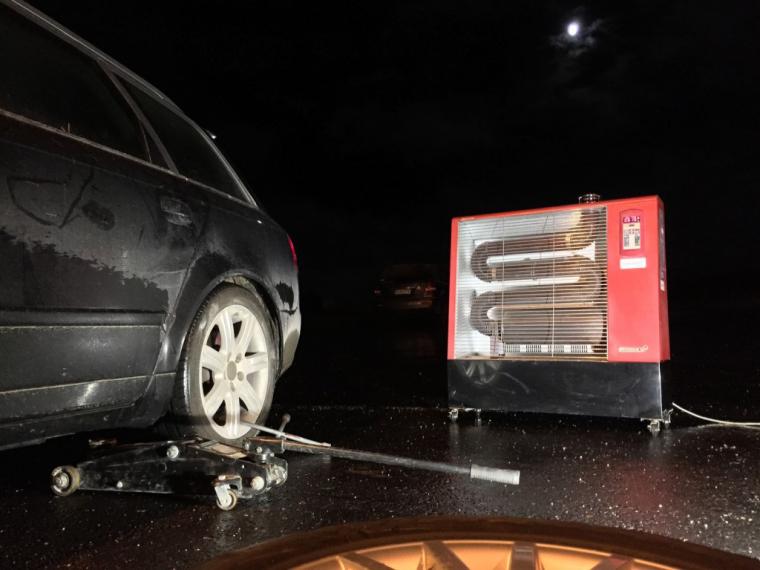
There are many significant differences between an infrared heater and a traditional fan heater. For instance, instead of blowing, infrared heaters radiate heat. Infrared radiation heats materials, not air. To learn more about infrared radiation, visit, for example, Wikipedia. You can feel the heating effect of an infrared heater even outdoors in windy weather because the heat will get through instead of being whisked away with the wind. The warm air blown from the fan heater will disappear in the wind right out of the heater. Rex Nordic infrared heaters are an excellent choice for, for example, service tasks that have to be performed outdoors, e.g. changing a tyre of a car or repairing machinery (forest harvester, tractor, etc.) in field conditions.
Considering a diesel heater? Tubular fan heater or a safe infrared heater?
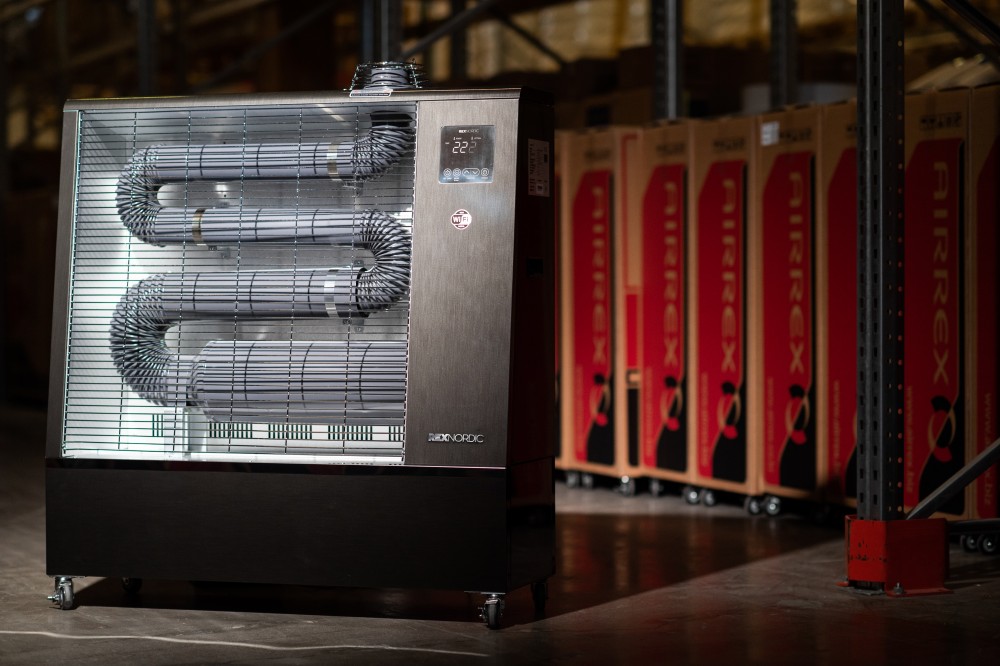
The energy contained in diesel or fuel oil can be used for heating by burning the oil. Simple traditional auxiliary heaters consist only of an oil burner and a fan that is used to direct the heat from the oil burner to the desired spot in the form of hot airflow. Rex Nordic infrared heaters also include an oil burner, but instead of a naked flame, the heat is formed in a heat generator doubling as the exhaust system. From the heat generator, the heat is radiated to the surrounding atmosphere in the form of infrared waves. The heat radiation can be directed using the heat reflector structures in the heater. Single- or multi-stage combustion diesel heaters The forced airflow of traditional oil heaters with a burner and fan transfers all particles of the burned oil, including exhaust gases and unburned particles, directly through the heater into the heated space. Even with an efficient burner, the exhaust gas will contain small amounts of unburnt hydrocarbons and any contamination in the fuel. This will cause different kinds of smoke and odour emissions. Basic tubular heaters simply use the fan to circulate the air in the heated space pass the oil burner. This means that unburnt hydrocarbons from the oil burner “supplement” any impurities already in the heated space air. The amount of unburnt hydrocarbons increases significantly if the diesel or fuel oil does not burn efficiently. This is usually the case during the starting or stopping of the heater or if there is a problem with the fuel supply to the burner. Rex Nordic infrared heaters burn the diesel or fuel oil very efficiently because, after the oil has been burned in the burner, practically all the remaining hydrocarbons are burned in the 3-stage exhaust system that doubles as the heat generator. In practice, the exhaust is left with only harmless carbon dioxide and water without any unburnt hydrocarbons causing unpleasant odours and/or health hazards. Rex Nordic auxiliary heaters utilise practically all the energy contained in the fuel, meaning that they are highly efficient and consume very little fuel. Exposed or protected oil burner? Basic fan-equipped diesel and fuel oil heaters have their oil burners in direct contact with the outside air, exposing them to any impurities and humidity in the air. This can result in corrosion or dirt build-up in the burner structures, decreasing the performance and reliability of the burner. If you use a fan-equipped auxiliary heater with an oil burner as the heat source, you must always make sure that the air going inside the heater does not contain any combustible material, such as dust, straws of hay or any combustible material that can be carried by the airflow. Another thing to remember when using this kind of a heater is that you also must consider the fire hazard caused by the hot air coming from the heater and any smouldering particles carried in it. In Rex Nordic infrared heaters, the oil burner is enclosed inside the device and has its own separate air intake channel. All air coming to the burner is burnt, and the resulting exhaust gases are directed to a long exhaust system that doubles as the heat generator. The flame of the burner is not in contact with the surrounding space, and exhaust gases and any sparks cool down and die out harmlessly in the exhaust system. The long exhaust system also protects the burner against damages due to any impurities and humidity in the air. Difference between heating by airflow and heating by radiation In case of a traditional oil burner, the hot naked flame heats the air directed past it by the fan. This means that the air in front of the auxiliary heater may be very hot. The heating effect becomes more even when the hot air mixes with ambient air. The heating effect of the heated air circulated by the fan can only be felt in places where the air can reach. In a large space with obstacles or structures blocking the airflow, there will be “nooks and crannies” where the heat cannot get. Heat energy radiated by an infrared heater does not heat the air but the objects with which it comes in contact. Therefore, you can be close to the heater without feeling uncomfortably hot. Heat radiation spreads evenly in the space, literally warming up the objects in its path from the inside out. Once the objects and structures in the heated space warm-up, they also warm up the space evenly. Do you want to circulate dust and air contaminants? Fan-boosted air circulation always circulates contaminants, dust and other impurities in the space as well. This spreads air contaminants everywhere, including people’s skin and lungs and from there further in the body. Heat radiation from an infrared heater does not cause any superfluous air movement that would cause dust or any contaminants in the heated space to migrate to the workspaces or supplies or in the bodies of people there. Humming fan and buzzing burner – or not? The humming sound of an efficient oil burner is familiar to all who have been around one. Traditional auxiliary heaters only have sound damping structures on the sides of the burner. And to ensure safe heater operation, the heated air must be made to move efficiently. This requires a fan that inevitably produces noise. Today, some high-end traditional auxiliary diesel heaters already have reasonably silent fans. In case of the fully enclosed Rex Nordic infrared heaters, the air to the oil burner is conveyed via a separate sound dampening channel. The exhaust system located downstream the burner utilises any energy left from the burned oil and also dampens the “exhaust noise” down to a very moderate level. Rex Nordic infrared heater’s noise level is 48 dB, corresponding with that of a quiet speaking voice. Burner requires electricity – a fan easily doubles the need for power Traditional auxiliary oil heaters have some components that require electric
Fuel-fired large space heater – how much supply air is needed, and other questions.
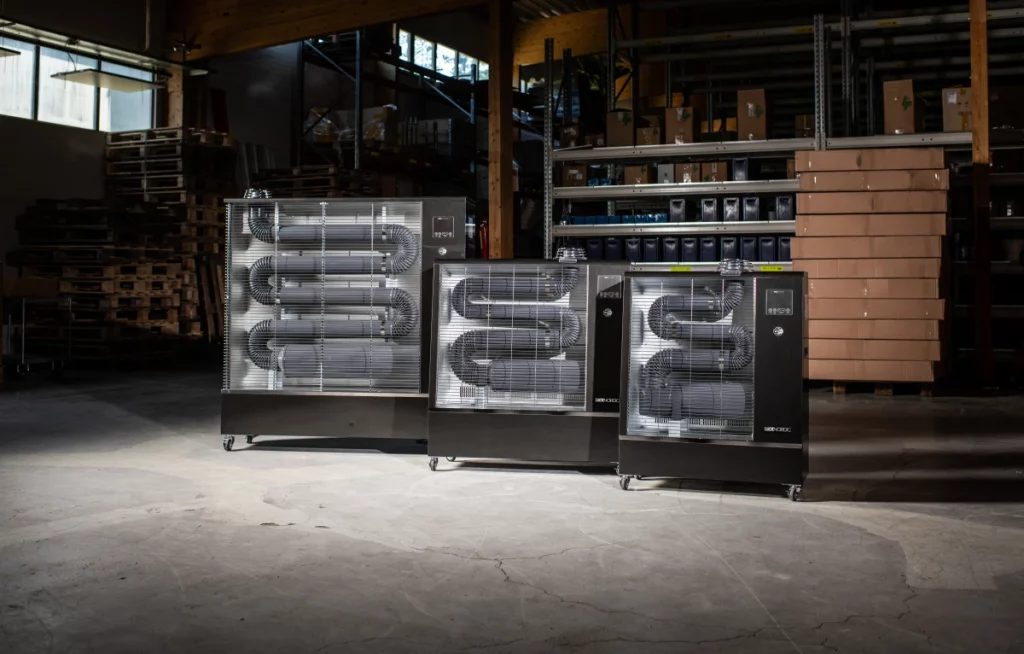
How is it possible to have a large space heater without an exhaust pipe? It is made possible by using pure high-quality fuel that ensures perfect combustion. Of the exhaust, more than 99% is carbon dioxide and water vapour that are parts of the air that we breathe. There is practically no soot or other fine particles, not even carbon monoxide. Exhaust from clean-burning high-quality fuel contains very low nitrogen oxide levels that do not constitute a health risk. Water vapour is in no way hazardous to health, and the moisture in the exhaust gas of Rex Nordic infrared heaters does not harm the structures of the heated space. Oil heater and carbon dioxide load There are two stages in warming up enclosed spaces, such as halls and warehouses: initial heating and continuous heating. During the initial heating, the fuel heater blows or radiates heat at maximum power, producing the maximum amount of exhaust gases. Once the space is heated, continuous heating only requires a fraction of the heater’s heating capacity. In this stage, Rex Nordic infrared heaters typically use only a small amount of fuel per hour. Due to the two heating stages, the exhaust load in the heated space also varies greatly. Therefore, the ventilation performance required to ensure an appropriate amount of supply air and a level of carbon dioxide suitable for people to breathe varies. Load on full heating capacity Rex Nordic infrared heaters are offered in three capacity classes. The heating capacity of the smallest Rex Nordic AH-210 is 13 kWh, the heating capacity of the medium Rex Nordic AH-310 is 15 kWh, and the capacity of the largest AH-810 is up to 22 kWh. The capacity is achieved by burning approximately 1.0–2.5 litres of fuel per hour. Burning 1.5 litres of fuel or diesel oil produces approximately four kilograms, or 4,000 grams, of carbon dioxide. The burning process requires approximately 22 cubic metres of air. Correspondingly, to burn 2.5 litres requires approximately 36 m3 of air and produces approximately 6,600 grams of carbon dioxide as a combustion product. The carbon dioxide produced by the heating makes working in the heated space more stressing. But when does it become a health risk? Carbon dioxide is not dangerous as such, but large concentrations are considered harmful Carbon dioxide is one of the normal gases in the air and, as such, not dangerous at all. On the contrary, the human body needs carbon dioxide to work. If the level of carbon dioxide in the air increases, we feel like we are “running out of breath” and the body reacts by automatically increasing the rate of breathing. A high level of carbon dioxide in the air is reported to cause headache, fatigue and a feeling of stuffy air. The amount of carbon dioxide in the air is expressed in ppm, or parts per million. The amount of carbon dioxide in the open air is approximately 380 ppm. According to the Decree of the Ministry of Social Affairs and Health on concentrations known to be harmful (HTP) and the Ministry of the Environment procedure on carbon dioxide levels in indoor air, the maximum allowed concentration of carbon dioxide during normal weather conditions and while the room is occupied is 1,200 ppm. The acceptable exposure limit at workplaces during an 8-hour workday is 5,000 ppm. This translates into carbon dioxide concentrations of half a per cent (0.5%) mixed in the air. Something about the level of stress caused by carbon dioxide on the human body can be deduced from the fact that submarine crews work and live in an atmosphere that contains approximately one per cent (10,000 ppm) of carbon dioxide. Even a concentration of 2%, or 20,000 ppm, has not been found to cause adverse health effects during short-term exposure. How much does an auxiliary oil heater increase the carbon dioxide concentration in a hall space? The specific weight of air varies according to the temperature and humidity of the air, the average used in these calculations being 1.225 kg/cubic metre (at sea level). Of this figure, the amount of carbon dioxide is 0.038% = 0.0004655 kg, or approximately 0.47 grams. The 5,000 ppm carbon dioxide exposure limit allowed at workplaces translates into approximately 6.125 grams of carbon dioxide per cubic metre of air. Considering the amount of carbon dioxide already in the air (0.47 grams/m3), the amount of extra carbon dioxide allowed to be mixed in the air is 5.655 grams. If we now presume that there is no ventilation whatsoever in a heated space with Rex Nordic AH-310 infrared heater blasting away at full capacity, how big must the space be in order to avoid any health hazard due to the exhaust? The four kilos, or 4,000 grams, of carbon dioxide produced per hour requires a space of approximately 710 m3to dilute below the 5,000 ppm concentration level. The area of a hall space that is four (4) metres high should, then, be approximately 180 square metres. Using the more powerful Rex Nordic AH-810 for an hour at full capacity would require a hall space of approximately 1,150 cubic metres to keep the increase in the carbon dioxide level below the recommended 5,000 ppm limit. Continuous heating requires only one-third or significantly less fuel compared to full capacity heating. This means that carbon dioxide emissions are only one-third or less by comparison. Subsequently, the volume of the heated space only needs to be 230–380 m3 to keep the carbon dioxide level below the recommended workplace exposure limit. The floor area of a 2.70-metre high hall space with a volume of 230–380 m3 is 85–140 square metres. The significance of ventilation The above examples are theoretical in nature because there are not that many heated spaces that are completely sealed. On the other hand, a combination of a particularly low ventilation setting and use of a fuel-fired heater will result in continuously increasing indoor air carbon dioxide levels, something that should be considered. If the heated space is ventilated
Moisture and diesel infrared heaters
When heating cold spaces, the moisture tends to condensate on windows, metal structures or other structures in the heated space. From where does this moisture actually come? As a rule, air contains humidity in the form of water vapour: the hotter the air, the more humidity there is in it. Cold air cannot hold as much moisture as warm air. Air that contains water vapour heats up quicker than solid structures. Warmer air gathers more water vapour, but the solid structures in the heated space remain cool. The air close to the structures cools down, and the amount of water vapour in the air exceeds 100% RH. When the relative humidity of air exceeds 100%, water vapour in the air starts to condensate into droplets visible particularly on windows and metal surfaces in the heated space. You can also witness the same phenomena on a frosty pint of beer on a terrace in the summer. Two measurement units for humidity The amount of water vapour in the air, or humidity, is described by two different concepts. One expresses the amount of water in the water vapour found in a cubic metre of air. This is referred to as absolute humidity. The other, relative humidity, expresses the percentage of water vapour contained in the air. Relative humidity may vary from totally dry air (0%) to saturated air (100%) that contains the maximum amount of water vapour possible. Oil heaters produce carbon dioxide and water vapour Rex Nordic infrared heaters burn diesel or fuel oil extremely efficiently, using almost 100% of the energy contained in the oil for the heating of the space. In practical terms, this means that all of the 10 kW of (heat) energy contained in a litre of fuel is utilised. 10-kW heating capacity is enough to significantly raise the indoor temperature in most heated spaces. Once the desired working temperature has been achieved, Rex Nordic heater’s thermostat steps in to control the heater, reducing fuel consumption and emissions. A litre of fuel or diesel oil burnt creates 2.7 kg of carbon dioxide and 560 grams of water. Heating dries the air The capacity of air to hold water vapour is almost directly proportional to the temperature of the air. The colder the air, the smaller the amount of water vapour it can contain. This explains why heating is the most effective way to dry out spaces. Even then, formation or entry of humidity from outside the heated space must be prevented. If the relative humidity in a largish hall space is 40% at 0 degrees Celsius, each cubic metre of air in the space contains 1.9 grams of water vapour (water). If additional humidity is prevented from entering the space, raising the temperature in the space from zero to +20 degrees Celsius reduces relative humidity to five (5) per cent. It does not take much to heat air The average heat capacity of air is 1.01 kJ/kg/°C, based on which it is possible to calculate the output needed to heat it. To raise the temperature of one cubic metre of air by one degree, you need approximately 0.00035 kWh of heating power. If the heated space is, for example, 300 m3 in size, the power required to heat the air in it from zero degrees to +20 degrees is just 2.1 kWh. In reality, however, the above figure is not enough because of the significant effect the structures and objects in the heated space have on the required heating capacity, not to mention any heat loss due to structural leaks and ventilation in the space in question. Humidity created by an oil heater is not a risk The fact of the matter is as follows: to heat a 300-cubic-metre space from zero to +20 degrees, you require about 10 kWh of power, or one litre of oil, at maximum. This translates into 560 grams of water vapour that is mixed with 300 cubic metres of air. The amount of water in each cubic metre of air is, then, increased by about 1.9 grams. If the initial amount of water vapour per cubic metre of air in the heated space was 1.9 grams, the figure after the heating would be approximately 3.8 grams. At +20 degrees Celsius, this translates into about 30% relative humidity, which will not cause a moisture damage risk to any structure whatsoever. Unique benefits of oil-fired Rex Nordic infrared heaters Radiation heaters do not heat the air as such, but the objects in the way of the infrared waves. Thus, the structures and objects in the heated space will become warm quicker than the air. This efficiently prevents condensation of humidity in the air on the surfaces, minimising the risk of damage due to moisture. Another factor that reduces the moisture risk is fuel. Many infrared heaters use liquefied petroleum gas, or LPG, which, when burnt, produces carbon dioxide and water. It is, therefore, a very clean fuel. Rex Nordic heaters are in practice just as clean, but they produce considerably less water than LPG heaters. One (1) kg of LPG produces approx. 12.8 kWh of energy when burnt. At the same time, 2.99 kg of carbon dioxide and 1.63 kg (1,630 grams) of water vapour are produced. Using diesel oil, the amount of water vapour produced to achieve the equivalent heating power is approx. 720 grams – less than half of that with LPG. This is a significant difference, at least for anyone wishing to minimise the risk of moisture damage. Infrared heat dries out structures As described above, infrared heating increases the temperature of the structures and objects in the heated space rather than the air. This prevents condensation of moisture on the surfaces of the structures. Infrared heaters can also be used to remove humidity in applications such as the drying of moisture damage from concrete structures, for example. If there is moisture in the structures of the heated space from the time of