
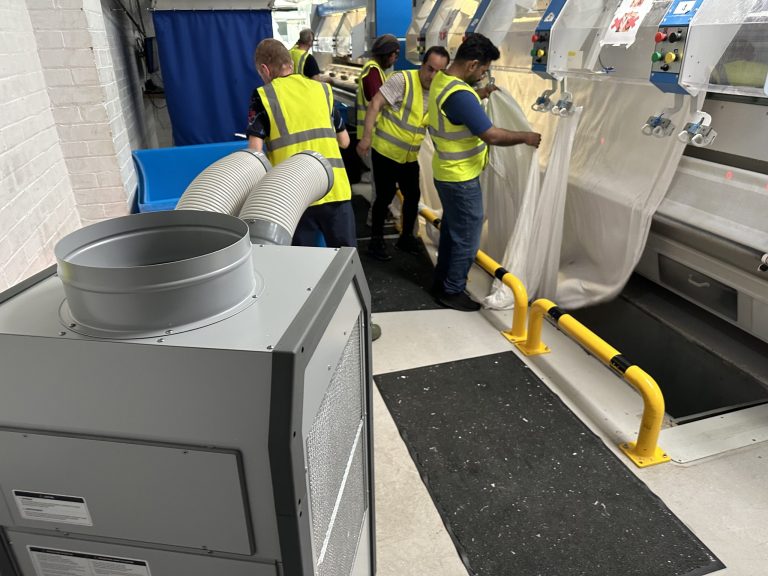
In commercial laundries, heat often builds up around specific workstations, such as sheet ironers, tumble dryers, and pressing stations, where equipment generates significant heat.
At a laundry facility in the UK, temperatures in the hottest areas exceeded +40 °C, creating difficult working conditions for staff.
The HP-19 portable air conditioner (19,000 BTU) provided targeted cooling exactly where it was needed, while also effectively reducing humidity.
Organisations such as the WHO and ILO highlight targeted cooling as an important way to manage heat in demanding indoor workplaces.
Laundry facilities are rarely considered particularly hot working environments, yet in practice they can become extremely demanding—especially during warmer periods of the year. At a professional laundry operation in the United Kingdom, heat accumulated around the sheet ironers, tumble dryers and pressing stations, where peak temperatures regularly rose beyond +40 °C.
Rather than spreading evenly across the facility, the heat remained concentrated around these individual workstations. This significantly affected employee comfort and endurance during busy periods. To improve the situation, the site introduced the Rex Nordic HP-19 portable air conditioner, allowing cooling to be directed precisely to the areas with the highest heat exposure.
Laundry heat loads are mainly caused by machinery
The primary source of heat in laundries is the machinery used in daily operations. Sheet ironers, tumble dryers, presses and other finishing equipment constantly release heat as wet textiles are dried, pressed and prepared for use. Much of this heat is emitted directly into the surrounding workspace—often exactly where employees are positioned throughout their shift.
As a result, temperature levels in laundries typically vary depending on the workstation. Rather than affecting the entire building equally, heat tends to build up around certain machines. Research indicates that employees working in these conditions may experience heat stress, which can affect concentration, stamina and physical performance. The U.S. Occupational Safety and Health Administration (OSHA) identifies laundries as environments where localised heat can increase fatigue and accident risk if temperatures are not actively controlled.
Excessive heat can also affect equipment. A cooler and more stable operating environment helps extend machinery lifespan, lowers maintenance requirements and reduces the likelihood of unexpected production interruptions. In this way, cooling improves both employee well-being and operational reliability.
Targeted cooling in practice: a 19,000 BTU solution for laundry environments
The HP-19 is a portable air conditioner with a cooling using a refrigerant cooling system, delivering a cooling capacity of 19,000 BTU per hour, equivalent to roughly 5,570 watts.
The BTU rating reflects how much heat the unit can remove from the air: the higher the figure, the more effectively heat can be transferred out of the space. In laundries, where sheet ironers, dryers and presses generate constant heat, this capacity allows the system to maintain effective cooling even during extended operation.
The HP-19 cools air using the same refrigeration principle as fixed air-conditioning systems. Because of the closed refrigerant circuit, the temperature can be controlled precisely and maintained consistently rather than providing only a temporary cooling effect. Users can set a desired temperature between 18 °C and 30 °C, and the unit automatically maintains that level—even during periods of very hot weather.
In this installation, the units were positioned specifically where heat was generated:
- on both sides of the sheet ironer
- close to the tumble dryers
- within the pressing area
Another important feature was the system’s strong dehumidification capability, removing up to 118 litres of moisture per day. Laundry facilities typically have high humidity levels, which can make heat feel significantly more uncomfortable. By reducing moisture in the air, the working environment becomes noticeably more tolerable without needing to cool the entire building.
The HP-19 can also contribute to improved air quality through different filtration options. In laundry environments, this can help reduce airborne lint and fibres, supporting better indoor air conditions for employees.
Why cooling was focused on individual workstations
Laundry plants are often large spaces with continuous workflows. Although a portable air conditioner can be suitable for rooms up to approximately 550 m³, cooling an entire hall is not always the most efficient approach when heat is produced locally around machinery. In such cases, a considerable portion of the cooling capacity would be wasted on areas that are not affected by heat.
For this reason, the cooling strategy was intentionally directed towards the workstations with the greatest heat load. This approach improved working conditions while also keeping energy use under control. By cooling only the necessary areas, the overall power consumption remained significantly lower.
The portable system made it possible to:
- deliver cooling directly to the employee’s workstation
- move units easily as production layouts or needs change
- install the solution quickly without structural alterations or production downtime
This strategy aligns with guidance from the World Health Organization (WHO) and the International Labour Organization (ILO). Both organisations recommend targeted technical measures to reduce heat exposure in indoor workplaces, particularly in areas where employees are exposed to elevated temperatures for extended periods.
Employee feedback – cooler conditions, easier workdays
Although the solution itself was straightforward, its impact on day-to-day work was clear. Employees reported that the hottest workstations became far more manageable, and shifts felt noticeably less exhausting even during warmer conditions.
Studies indicate that even modest reductions in temperature and humidity can improve focus, reduce fatigue and support better overall job satisfaction. In this case, the benefits were quickly reflected in daily operations and staff experience.
Portable air conditioning as part of a practical workplace solution
The laundry facility continues to operate as before, but the environment around its hottest workstations has improved considerably. The portable air conditioner proved to be a practical option in a setting where heat is generated mainly by machinery rather than outdoor temperatures.
When cooling and dehumidification are applied in a targeted way, it is possible to improve working conditions without major structural changes to the facility. The HP-19 is particularly suited for professional environments where flexible, quickly deployable cooling solutions are required.
More information about the HP-19 portable air conditioner.