
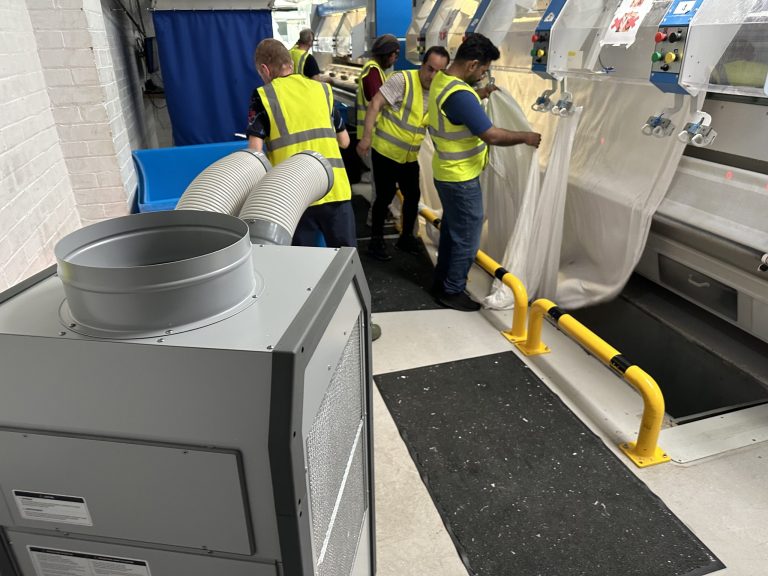
- In laundries, heat tends to concentrate at specific workstations such as sheet ironers, tumble dryers and pressing equipment, where large amounts of heat are generated.
- In a UK-based laundry, temperatures in the hottest areas rose to well over +40 °C, placing significant strain on employees.
- The HP-19 (19,000 BTU) portable air conditioner enabled precise, targeted cooling combined with effective dehumidification.
- WHO and ILO emphasise the importance of targeted cooling solutions in managing heat in hot indoor working environments.
The heat did not spread evenly throughout the facility but accumulated at these specific workstations. This had a direct impact on employee comfort and endurance. To address the issue, the site selected the Rex Nordic HP-19 portable air conditioner, allowing cooling to be focused precisely where the heat was felt most intensely.
Heat challenges in laundries originate from machinery
The heat generated in laundries is a direct result of the machinery used in daily processes. Sheet ironers, tumble dryers, pressing and other finishing equipment continuously produce large amounts of heat as wet textiles are dried, ironed and finished. This heat is released directly into the workspace—often exactly where employees spend long periods working next to the machines.
As a result, heat does not distribute evenly across the entire laundry but concentrates at certain workstations. International studies show that in such environments, employees are exposed to heat stress, which can reduce stamina, concentration and physical performance. The U.S. Occupational Safety and Health Administration (OSHA) recognises laundries as workplaces where localised heat can increase fatigue and accident risk unless heat loads are actively managed and cooling is properly targeted.
High temperatures also place additional strain on machinery. A more stable and cooler operating environment supports equipment durability, reduces maintenance needs and lowers the risk of unplanned production downtime. In this way, cooling benefits both employee working conditions and overall operational reliability.
Targeted cooling in practice: a 19,000 BTU air conditioner in laundry use
The HP-19 is a refrigerant-based portable air conditioner with a cooling capacity of 19,000 BTU per hour, equivalent to approximately 5,570 watts. The BTU value indicates the unit’s ability to remove heat energy from the air: the higher the rating, the more heat the unit can transfer out of the space. In a laundry environment, where sheet ironers, tumble dryers and presses generate heat continuously, this level of capacity enables effective cooling even during prolonged operation.
The HP-19 cools air using the same principle as fixed air conditioning systems. Thanks to the refrigerant circuit, temperature control is precise and reliable, rather than a short-term cooling effect. In cooling mode, the user can set a target temperature between 18 °C and 30 °C, and the unit automatically maintains the selected temperature even during heatwaves.
The units were deployed on a workstation-specific basis:
- on both sides of the sheet ironer
- near the tumble dryers
- in the pressing area
A key factor was also the air conditioner’s high dehumidification capacity, removing up to 118 litres of moisture per day. High humidity is typical in laundries and makes heat feel heavier and more exhausting. When moisture is controlled, heat is perceived as significantly more tolerable and working conditions improve—without the need to lower the temperature throughout the entire facility.
The HP-19 can also be used to improve air quality through different filtration options. In laundry environments, this can reduce airborne dust and fibres, helping to improve indoor air quality and support employee working conditions.
Why was cooling focused only on specific workstations
Laundry facilities are often large, with continuous production processes. Although a portable air conditioner may be suitable for spaces of up to 550 m³, cooling an entire hall is not always the most practical solution if heat is generated locally around machinery. In such cases, a large portion of the cooling capacity would be directed to areas where heat is not the primary issue.
In this case, cooling was deliberately targeted at the workstations with the highest heat load. This not only improved working conditions but was also an energy-efficient solution: by avoiding unnecessary cooling of the entire space, overall energy consumption remained significantly lower.
The portable air conditioner made it possible to:
- deliver cooling directly to the employee’s working area
- reposition units flexibly according to production flow and workstation needs
- deploy the solution quickly, without structural modifications or production downtime
This approach is in line with recommendations from the World Health Organization (WHO) and the International Labour Organization (ILO). Both organisations emphasise that in hot indoor working environments, heat exposure should primarily be managed through targeted technical solutions, especially at workstations where employees are exposed to heat for extended periods.
Employee experience – less heat, a better working day
Although the solution was technically simple, its impact on everyday work was clearly noticeable. Employee feedback was unanimous: the hottest workstations became manageable, and the working day felt lighter even during periods of high temperatures.
Research shows that even a moderate reduction in temperature and humidity can improve concentration, reduce fatigue and increase job satisfaction. In this laundry, the improvement was quickly reflected in daily work and in employee experience.
A portable air conditioner as part of a functional working environment
The British laundry continues operating as before—but conditions at the hottest workstations are now clearly better. The portable air conditioner proved to be a practical solution in an environment where heat is generated by machinery rather than outdoor conditions.
When cooling and dehumidification are correctly targeted, working conditions can be improved without major modifications to the facility. The HP-19 is particularly well-suited for professional use, targeted cooling and situations where a flexible, rapidly deployable solution is required.
More information about the HP-19 portable air conditioner.